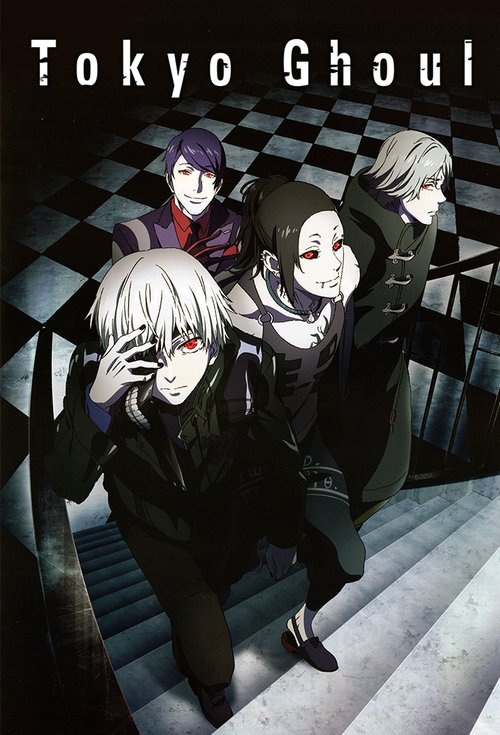
The Tokyo Ghoul watch order comes with a famous continuity problem: the second season diverges from the manga, and the third season follows the manga anyway. This guide solves the Tokyo Ghoul watch order plainly — the four seasons in order, what Root A changes, and how to enjoy :re without getting lost.
Start With Season 1
Begin with Tokyo Ghoul (2014), in which student Ken Kaneki, voiced by Natsuki Hanae, becomes a half-ghoul after a near-fatal encounter and must navigate a hidden world of flesh-eating ghouls and the investigators who hunt them. Season 1’s 12 episodes adapt the manga’s opening faithfully and end with Kaneki’s transformation into something harder and darker. It is the strongest starting point the series offers, and everything after it builds on the question it leaves: what does Kaneki become when he stops holding back?
The Root A Problem
Season 2, Tokyo Ghoul √A (2015), is where the continuity problem begins: instead of adapting the manga’s next arc, it tells an original story in which Kaneki joins the ghoul organization Aogiri Tree. The broad strokes — Kaneki’s descent, the raid on Anteiku, the suffering of his friends — rhyme with the manga, but the details differ. This matters because Season 3 does not follow from √A: it follows from the manga. If you expect a clean chain of cause and effect, √A will confuse you; if you treat it as an alternate telling of the same period, it works as a dark, self-contained tragedy.
How :re Fits
Seasons 3 and 4, Tokyo Ghoul:re and :re 2nd Season (both 2018, 12 episodes each), pick up after a time skip with a new investigator, Haise Sasaki, whose identity is the season’s central mystery. The :re seasons adapt the manga’s sequel storyline, which means they assume the manga’s version of events after Season 1 — not √A’s. The practical advice is simple: watch :re as a continuation of the manga’s story, accept that some details will not line up with √A, and focus on the emotional throughline, which survives the gap: Kaneki’s search for a place where ghouls and humans can coexist. The :re seasons also reintroduce the surviving cast gradually, so even if a plot detail puzzles you, the characters will orient you within a few episodes.
Why the Order Still Works
It helps to remember that Tokyo Ghoul is only 48 episodes in total — short by long-anime standards — so the continuity wrinkle costs you a little confusion, not a wasted season. Watched in release order, the series still delivers a complete arc: a young man’s fall, his years in the dark, and his attempt to build something better from the wreckage. The gap between √A and :re is real, but it is also the reason the series is still discussed a decade later: fans love arguing about which version of Kaneki’s middle years is the true one, and that argument is part of the show’s legacy.
The Manga Bridge, If You Want It
If the gap bothers you, the manga is the bridge: reading the original Tokyo Ghoul manga’s second half before :re gives you the version of events that :re continues, and it turns √A into a fascinating what-if rather than a contradiction. This is optional, not required — the anime is watchable on its own — but it is the only way to make every season line up perfectly. Many fans consider the manga the definitive version of the story, and the anime a companion to it rather than a replacement.
The Full Order, Summarized
The Tokyo Ghoul watch order is: watch Tokyo Ghoul Season 1, then √A as an alternate telling, then :re and :re 2nd Season as the manga’s continuation — or read the manga’s second half between √A and :re for a seamless story. For another anime where the adaptation path needs untangling, the Sword Art Online watch order has its own retellings to sort — but none quite as tangled as this one.
Leave a Reply