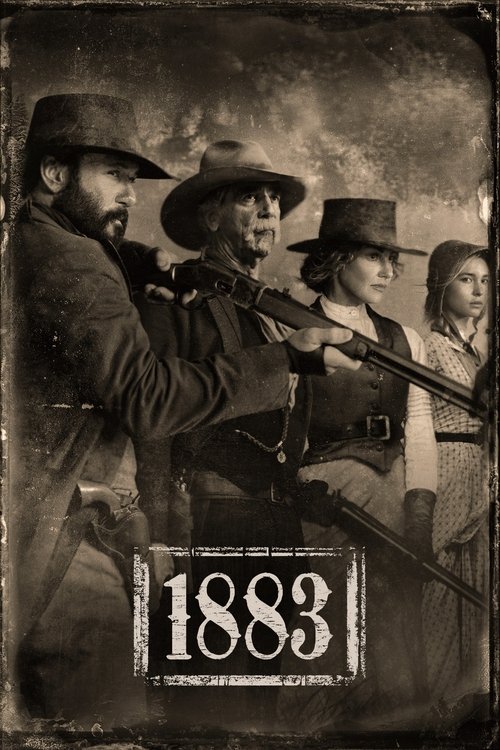
1883 true story history is a question that comes up fast, because Taylor Sheridan’s Yellowstone prequel feels so real that viewers assume the Duttons were a real family. They were not. 1883 is fiction — James, Margaret and Elsa Dutton are invented characters — but the world they travel through is built from genuine Oregon Trail history, and the dangers that kill its characters are the dangers that really killed pioneers.
The Duttons Are Fiction — the Trail Is Not
1883 follows the Dutton family leaving Texas in 1883, joining a wagon train led by the former soldier Shea Brennan (Sam Elliott) and heading north toward Montana, where they will found the Yellowstone ranch. None of the Duttons existed: Sheridan created them as the ancestors of Yellowstone’s John Dutton. What is real is the migration itself. Between the 1840s and 1869, hundreds of thousands of Americans traveled west in wagon trains, most along the Oregon Trail, a roughly 2,000-mile route from Missouri jumping-off towns like Independence to Oregon’s Willamette Valley. The show’s wagon train, with its guides, its rules and its fragile order, is a faithful picture of how those journeys were organized.
The Real Dangers: Disease, Rivers and Accidents
The show’s most harrowing episodes are also its most accurate. Disease was the great killer of the trail: cholera, dysentery and measles swept through camps, and historians estimate that roughly one in ten travelers died on the journey, most from illness rather than violence. River crossings were the second great danger — wagons overturned and people drowned in swollen rivers, just as the show depicts. Accidents with wagons, firearms and livestock filled out the toll. Sheridan’s show gets this hierarchy right: the trail killed mostly through sickness and bad luck, not through the gunfights that dominate western movies.
What the Show Changes: Texas, the Route and the Timeline
1883 takes liberties with geography and timing. Real Oregon Trail wagon trains typically departed from Missouri, not Fort Worth, Texas, where the show begins — Sheridan starts in Texas because that is where the Duttons live, not because it was a trailhead. The show’s route to Montana also bends the map: the Duttons peel off toward the Paradise Valley, a fictional version of Montana ranch country, while the historical trail pushed on to Oregon. And the year 1883 is late for a classic wagon-train journey: by then the transcontinental railroad, completed in 1869, had made the long overland wagon journey largely obsolete. The show uses 1883 because it needs the Duttons in Montana a set number of years before Yellowstone, not because wagon trains were still common then.
Native Peoples and the Show’s Honesty
1883 is unusually careful about Native peoples for a western. The show depicts Comanche and Lakota characters with their own motives, and its portrayal of the violence of westward expansion is darker than the genre’s usual version. Historically, most encounters between wagon trains and Native peoples involved trade or peaceful passage, though conflicts — and the larger tragedy of dispossession — were real and devastating. The show compresses that history into individual encounters, but it does not pretend the land the Duttons claim was empty. That honesty is one reason the series is taken seriously as history-adjacent drama rather than simple mythmaking.
The Bottom Line
So is 1883 a true story? No — the Duttons, Shea Brennan and Elsa’s narration are fiction. But the history around them is real: the wagon trains, the cholera camps, the river crossings and the hard arithmetic of a journey where one traveler in ten never arrived. Sheridan’s trick is to wrap invented people around documented facts, so the fiction feels true because the world is true. If you like that kind of history check, our Shōgun guide separates the real William Adams from Blackthorne in the same way.
Ready to rewatch the journey? Start with 1883 on Paramount+ and watch for the trail’s real dangers behind the drama.
Leave a Reply